Sunday, 22 December 2013

How Oliver Cromwell stole Christmas

No Christmas for you! 


Does Christmas make you want to shout Bah Humbug? You are not alone. Nor is the much touted "War Against Christmas" anything new. Oliver Cromwell goes down as history's biggest Grinch. The Lord Protector and his Puritan-led parliament literally stole Christmas in mid-17th century England.

A fervent Puritan, Cromwell was on a mission to cleanse his nation of what he perceived to be papist excess and decadence. He and his fellow Puritans regarded Christ's Mass as an unwelcome revenant of Catholicism, "a popish festival with no biblical justification." Nowhere in the Bible, they argued, were people asked to celebrate Christ's nativity on December 25. Moreover, in Cromwell's mind, the wild, hedonistic excesses associated with the Twelve Days of Christmas, stretching from Christmas Eve to Twelfth Night, undermined core Christian beliefs.

On November 19, 1644, Parliament resolved that Sunday was the "only standing holy day under the New Testament" and within a week they decided that no other holy day would be recognized. The new national liturgy issued on January 4, 1645, made no provision for Christmas and thus its abolition was legally achieved, although a parliamentary ordinance declaring Christmas celebrations a punishable offence was not passed until 1647.


Traditionally the Twelve Days of Christmas was a time of feasting, merrymaking, drinking, mumming, gaming, and dancing. Special plays and masques were performed. It's no accident that one of Shakespeare's most popular comedies is named Twelfth Night after the festive date of its début performance.

The Puritans viewed these festivities as wasteful vanities, an excuse for misrule, drunkenness, promiscuity, gluttony, and gambling. Under Puritan rule, all activities related to Christmas celebrations, including Anglican religious services, were banned and driven underground. In London, soldiers were ordered to seize special foods cooked in celebration of Christmas, such as roast goose. The day of Christ's birth was no longer a holiday--people were expected to be seen at work and were questioned if they were not. The sacred significance of the day could only be legally observed with fasting and private prayer. Exchanging gifts, wearing fine clothes, feasting, and dancing were punished with a fine of five shillings.

 The ban on Christmas endured after Cromwell's death in 1558 and was only repealed with the Restoration of 1660. Likewise the Puritans of New England banned Christmas in Boston between the years 1659 and 1681.

In Restoration-era England, the Anglican Church resumed its traditional Christmas observances. However, hardline Protestants, such as the Presbyterian Kirk in Scotland, continued to discourage Christmas celebrations long after Cromwell's demise.


Richard is a friend of mine, born in the 1960s in a remote village in the Scottish Highlands. In his tight-knit, kirk-attending community, he never celebrated Christmas. Instead the midwinter revels took place at Hogmanay, the Scottish New Year's celebration, an unabashedly hedonistic celebration of dancing, drinking, parades, and festivals.

Hogmanay, like many folkways related to Christmas itself, may have its roots in ancient, pre-Christian Celtic or Norse midwinter celebrations.

 "We drank like heathens," Richard remembers fondly.

 No doubt Cromwell is rolling over in his grave.

Source: Ronald Hutton, The Stations of the Sun: A History of the Ritual Year in Britain

Sunday, 22 September 2013

Hildegard: Reconciling Faith & Science

by Mary Sharratt


September 17 marked the feast day of Saint Hildegard of Bingen (1098-1179), the 12th century Benedictine abbess, composer, and Doctor of the Church.

Saint Hildegard, that famously broad-minded polymath, also wrote the Western world’s first known description of the female orgasm:


When a woman is making love with a man, a sense of heat in her brain, which brings forth with it sensual delight, communicates the taste of that delight during the act and summons forth the emission of the man’s seed. And when the seed has fallen into its place, that vehement heat descending from her brain draws the seed to itself and holds it, and soon the woman’s sexual organs contract and all parts that are ready to open up during the time of menstruation now close, in the same way as a strong man can hold something enclosed in his fist.
Hildegard von Bingen, Causae et Curae

How could a celibate nun write such a convincing description? Unlike some people in our own age, Hildegard saw no contradiction between science and religion, between being a religious woman and addressing every aspect of human experience, including sexuality.

Born in the lush green Rhineland in present day Germany, Hildegard was a Renaissance woman long before the Renaissance. She founded two monasteries, went on four preaching tours, and composed an entire corpus of sacred music. Her prophecies earned her the title Sybil of the Rhine. She was indeed a visionary in every sense of the word.

Hildegard wrote nine books on subjects as diverse as cosmology, botany, linguistics, and medical science, as well as theology. Even though she believed consecrated celibacy to be the highest calling, her medical text, Causae et Curae, discusses female (and male) sexuality frankly and without moral judgment. There is not a trace of prudishness or anti-intellectualism in her work.

In general, medieval thinkers, including monastics, were far more plain-spoken in addressing sexual matters than many of us might expect. But Hildegard’s writing on sexuality was unique in its inclusion of female experience, unlike that of her male confreres, such as Constantine the African, the 11th century monk whose book De Coitu manages to discuss every conceivable carnal pleasure without once mentioning women.

As the woman who coined the word Viriditas, or “sacred greening power and vitality,” Hildegard felt a profound connection to the natural world, which she regarded as the visible face of the invisible Creator who permeates every living thing. Her book Physica was devoted to natural science and is an encyclopedic study of plants, trees, mammals, reptiles, birds, marine life, stones, metals, and elements, describing their physical and medicinal properties. She lists in extraordinary detail the 37 varieties of fish to be found in the Nahe, Glan, and Rhine Rivers.

Her vision of the cosmos changed to reflect the science of her age. In Scivias, her first work of visionary theology, the universe appeared as a mandorla—shaped like an egg or almond.


But by the time she wrote De Operationae Dei, the third and final book in her visionary trilogy, her visions reflected the cosmos as a sphere.


Over eight centuries after her death, Hildegard was finally canonized in May, 2012. On October 7, 2012, she was elevated to Doctor of the Church, a rare and solemn title reserved for theologians who have made a significant impact. Presently there are only thirty-four Doctors of the Church, and only three besides Hildegard are women (Catherine of Siena, Teresa of Ávila, and Thérèse of Lisieux).

My novel, Illuminations, based on Hildegard's dramatic life, is released in paperback on October 15.


Tuesday, 10 September 2013

ILLUMINATIONS in Paperback, Fall Author Events, and Virtual Tour!


Like billowing clouds, like the incessant gurgle of the brook, the longing of the spirit can never be stilled.
--Hildegard von Bingen


Dear Friends,

I've had a very busy, productive summer.

My novel ILLUMINATIONS: A NOVEL OF HILDEGARD VON BINGEN has won the 2013 Nautilis Gold Award: Better Books for a Better World.

October 15, 2013, ILLUMINATIONS will be released in trade paperback. I think the cover is absolutely lovely!

Be sure to catch my Virtual Book Tour, beginning in October, which features book giveaways, reviews, contests and more.

I will also be visiting Minnesota for author events:

2:30 pm on Friday October 11, I will be speaking about ILLUMINATIONS at the Minnesota Library Association Convention's Break Out Books Series at St. Cloud's River's Edge Convention Center, 10 4th Ave. S., St. Cloud, Minnesota

10:00 am on Saturday October 12, I'll be visiting the Book Group at Fridley United Methodist Church, 680 Mississippi St. NE, Fridley, Minnesota.

2:00 pm on Sunday October 13, I'll be speaking in the Wilder Room at Chanhassen Library, 7711 Kerber Blvd, Chanhassen MN 55317

7:00-9:00 pm on Tuesday October 15, I will be joining Gabriel Ross of Creative Spirit for an An Evening Celebration of Hildegard of Bingen at Wisdom Ways Center for Spirituality, Carondelet Center, 1890 Randolph Avenue, St. Paul, MN 55105. This very special event will include presentation, conversation, and ritual surrounding Hildegard's music, theology, and life and a discussion of what Hildegard's work offers women today.

I'll also be visiting some wonderful Twin Cities private book groups.

1:00 pm, October 30, the Luann Dummer Center for Women's Book Club will be discussing ILLUMINATIONS. I will be attending via Skype. Luann Dummer Center for Women, University of St. Thomas, 2115 Summit Avenue, St. Paul, MN 55105

If your book group would like to have me visit via Skype, please email me via my website. I love book groups!

In other news, my new novel in progress, THE DARK LADY’S MASQUE, the story of Aemilia Bassano Lanier, the first professional woman poet in Renaissance England, and her collaboration—and star-crossed love affair—with William Shakespeare, as his Dark Lady, sold to Nicole Angeloro at Houghton Mifflin Harcourt. The publication date will probably be sometime in 2015. I'm really enjoying writing this new novel!


Tuesday, 21 May 2013

Yoga & Writing: How Yoga Can Help Your Writing


Guest post by Stephanie Renée dos Santos 

Are you a writer? Novelist? Do you sit at a desk and computer, week after week, month after month, year after year? Any tightness or pain in your neck, shoulders, upper back, lower back, hips, or legs? A regular gentle Hatha Yoga practice with breath work can relieve and reverse these stressors, as stress in the body can inhibit creativity. When the body is relaxed, so are tensions of the mind, allowing imagination to flow freely.

I am a writer and yoga guide and practice yoga daily to help my writing endeavors. My suggestion for writers to get started with yoga is to locate in your area a yoga teacher who leads therapeutic style yoga like Yoga Therapy, Viniyoga, Yin Yoga or Kum Nye Yoga (Tibetan Yoga).  Initially, find classes with gentle and slow stretching combined with breath work.  On outset, share with the yoga instructor where your problem areas are in your body and/or mind so they can best assist you.  As your practice grows your inner voice will become clear, present, and will aid you in seeking out other types of yogic practices that will continue to help you in realizing your best self, authentic voice, and creative fire.

I highly recommend for the first 2 ½ months of starting up your yoga practice to attend classes 5 days a week, the reason is that it takes on average 66 days to form a new habit, according to new research by Phillippa Lally and colleagues from the Cancer Research UK Health Behavior Research Center as published in European Journal of Social Psychology. And you will immediately experience the benefits of yoga.

If it is not possible for you to attend this many classes a week with a local teacher or not at all, I suggest these DVD videos as supplements:

1.      Ana Forrest Yoga DVD “Strength & Spirit plus Embodying Spirit” for $20.  This DVD takes you through a regular hour long class which I have really enjoyed.

2.      And/or try Gary Kraftsow’s Viniyoga Therapy DVD’s  “For the Upper Back, Neck & Shoulders” and “For the Low Back, Sacrum & Hips” at $24.95. Gary’s instruction is on the clinical side, with good explanations of the stretches and how they work.

It is important to note that should you experience pain after doing a pose, listen to the wisdom of your body/mind and stop doing that position for a while, trying it again at a later date. Always honor yourself and your limits. After 2 ½ months of dedicated practice, try easing into practicing 2-3 times a week. At this point, more than likely, you will have experienced deep relief from bodily tensions and will easily want to continue your practice.

I love this quote by yogi/activist/writer Mahatma Gandi:

“Your beliefs become your thoughts,
Your thoughts become your words,
Your words become your actions,
Your actions become your habits,
Your habits become your values,
Your values become your destiny.”

The benefits of yoga for your writing?

1.       General physical comfort in the body and mind, making it easier to keep writing for days, weeks, months, and years on end.

2.      Developing a regular yoga practice helps reinforce discipline to write regularly.

3.      Yoga requires focus of concentration to enter, hold, and exit poses, as you develop this inner faculty it naturally becomes applied to writing projects.

4.      “Staying power” is developed as you try to hold a pose and this helps to then write-through difficult passages and obstacles all writers meet along the way when creating and structuring works.

5.       Inspiration and ideas spring or trickle forth when we are in a state of calm and our mind and heart are open, through yoga one learns how to access this state and stay there.

6.      You can learn how to set intentions/goals for your writing through the practice of guided meditation called Yoga Nidra.

7.       As you develop flexibility in the body that flexibility stretches to the mind, enabling creative thought processes and increased problem solving ability that naturally helps one through the writing process.

In general a writer will experience ease of body, mind, and an uplift of spirit with consistent yoga practice that in turn helps all aspects of living and writing.

Namaste!

Stephanie Renée dos Santos is a writer and yoga guide who teaches weekly yoga classes in Garopaba, Brazil. Currently, she is working on a historical novel: CUT FROM THE EARTH. She also leads/co-leads, half-day to week-long Saraswati Writing & Yoga Workshops in the USA and Brazil, should you like to explore briefly or intensely the synergy of writing and yoga. For more information visit Stephanie’s blog and workshop schedule


Sunday, 12 May 2013

A Mother’s Day Gift from the Garden of Dreams


Guest Post by Carolyn Lee Boyd

For the past century, the greatest gift that mothers have been giving their daughters is their dreams. Each generation has opened up new opportunities for the next and given their daughters the courage and confidence to make the most of them. If we think of what life in 1913 was like -- when women could not vote or pursue most careers, domestic violence was to be suffered silently, constant child-bearing was expected, and women’s lives were repressed in so many ways -- we understand how much each generation received from their mothers and then passed on to their own daughters.

Dreams are like spirits, like living beings who thrive on being shared and loved. We have been given so much by our mothers, grandmothers, and great-grandmothers, for Mother’s Day. Can we close the circle by giving their dreams back to them? If you are lucky enough to have your mother and even grandmothers still living, can you find a way to honor their unrealized dreams? If your mother always wanted to be a published author, can you perhaps self-publish some of her work and make her a gift of the book? If she wanted to travel to someplace, but she is now no longer able to go far from home, can you take her to a cultural evening of song and dance or make her a Mother’s Day meal from her favorite destination?

For those of us who have lost our mothers and grandmothers, we can still give them a gift by living out their dream for them in a way that would have made them proud. My friend Diane Saarinen recently realized that her career providing marketing and publicity to renowned authors through the Saima Agency (link-http://www.saimaagency.com ) brought her into the same kinds of luxurious Manhattan apartment buildings as a guest that her mother had once worked in as a housekeeper. Now when she walks into one of those buildings, she knows she is honoring her mother and all she was able to accomplish in providing for her family by all those years of labor. Diane also named the agency after her mother, whose first name was Saima.

For me, I have just recently realized that both my mother and grandmother were warriors. My grandmother, for example, fought for her own and her family’s survival during the Great Depression when the family was virtually homeless, and was always very clear about making her opinions known. My mother was also a fighter as an avid supporter of social justice causes and signed up for a 30-year stint in the Navy as a nurse at a time when girls from her community stayed home and taught Sunday School. Perhaps for Mother’s Day I can find a way to “fight the good fight” for some cause for which they would have championed were they still with me on Earth.

Still, perhaps the greatest gift we can give our mothers, whether they are still with us or not, is to do something positive to make our own dreams come true. As a mother myself, I know that nothing is dearer to my heart than having my own child follow his brightest star. For Mother’s Day, can you choose the dream you have always had but that you perhaps never told anyone because you thought it was too outrageous? If you have always wanted to sing before an audience but cannot really carry a tune, can you start voice lessons so you can join an amateur chorus? If you have always wanted to paint but did not think you had the time or ability, maybe Mother’s Day is a good day to go out and buy a paint set.

And once you have made headway towards that task, how about doing something to improve the lives of the women who will come after us all? I saw in my own mother and grandmothers how their sights turned to future generations from all over the country and world once their own offspring were out on their own. Is there a cause dear to your mother’s heart that you can spend time benefitting together on Mother’s Day? If you have lost your mother, what ways did she make life better for those who came after her that you can continue, if even for just one day? Having grown up in a segregated community, my mother was an avid supporter of the Southern Poverty Law Center. Maybe for Mother’s Day I can contribute or find another social justice organization in my own community that could use a day of service.

Mother’s Day is a time to honor our mothers and grandmothers in ways that go beyond flowers and cards. For those of us who honor divinities expressing the Great Mother whose compassion and hope for all beings is infinite, making dreams burst into bloom like roses on a rosebush for those in generations past, present, and future is a sacred act. This Mother’s Day, give the gift of a bouquet from the Garden of Dreams, a mother’s paradise.

Visit Carolyn Lee Boyd at her blog, Goddess in a Teapot.

Thursday, 31 January 2013

Celebrating the Icy Mystery of Imbolc


Guest post by Carolyn Lee Boyd


Imbolc is traditionally the celebration of the very first stirrings of life in the spring. In New England where I live, however, Imbolc is the season of ice. The fluffy December snowflakes have been shoveled into piles and compressed into a landscape of ice mountains and fields of solid, slippery whiteness. Ice dangles from the stark trees and clings to the sides of houses, stone walls, and lampposts. For many years I wished for an early spring and for the February ice to melt quickly, but now I think that an icy Imbolc has its own wisdom to ponder.

Like humans, with our body/mind/spirit, water has three natures as ice/water/steam. If we associate these components, and consider ice to be like our solid earthly bodies, water as our freely flowing minds, and steam to be our heavenly-bound spirits, the season of ice is that time when we are most concerned with our physical being. I find that to be true of Imbolc. In times gone by here in New England, winter was a time of a struggle for physical survival, when many people were most concerned about whether their food stores would hold out and the woodlots provide enough heat until the crops and warmth returned in the spring. At the same time, Imbolc in its traditional meaning is the time when Earth’s physical being is re-emerging in the form of baby animals and the first plant buds and we are reminded that even below the seemingly dead ground new life is growing.

Icy Imbolc has much to teach us about our bodies and the physical world. Ice is magic. Its beauty appears in the shimmer of color when light hits it at just the right angle, in its cathedral shapes, in the rhythmic waves it forms across fields. It seems to be sentient in the way crystals combine to build the complex, perfect, and exquisite patterns of snowflakes and rime on the windows. Like ice, our bodies are also outrageously beautiful, complex, perfect, and exquisite if we really look at them and appreciate all that must happen in order to give us each moment of life. Ice holds life in the form of water until it can be released in the spring to nourish the young plant and animal beings in suddenly flowing springs, rising water tables, and vernal pools. Our bodies, too, hold life within us until we are ready to bring it forth into the world as children, art, kind acts, and other forms of creation.

Finally, ice and Imbolc teach us the importance of being able to move among our three natures at will. Ice covers our world when it must in winter, thaws to water that offers new birth in the spring, then rises as evaporation, becoming clouds, all coming together in the water cycle that makes life on our planet possible. We, too, must be able to move among our body, mind, and spirit selves as we need to and developing each fully over our lives. Too often we have been taught that our bodies, minds, and spirits are separate and that one is more important than the others. Only when we are one inter-connected being, like our Earth’s water cycle, can we be all that we are meant to be.

As we prepare for Imbolc, perhaps we can take the time to create our own ice ritual. If you live someplace where February is icy, why don’t you go outside for a walk and notice all the ways ice manifests itself. You might sketch some drawings or bring a blank book and make notes for poems or inspirational thoughts. When you come home, think what the ice you have seen – and maybe touched, tasted, heard, and even smelled --  teaches you. You might even create artwork about the ice and what it means to you for your altar to remind yourself of the mystery of ice when the warm days lead you away to the green and lush world of the spring. This Imbolc, instead of wishing for the disappearance of ice to hasten spring, enjoy it, learn from it, and honor it.

Carolyn Lee Boyd is a human services administrator, herb gardener, and writer whose work focuses on the sacred in the everyday lives of women. Her essays, short stories, memoirs, reviews and more have been published in numerous print and online publications. You can read more of her work at her blog.

Monday, 21 January 2013

The Soul is Symphonic: The Music of Hildegard von Bingen


Born in the Rhineland in present day Germany, Hildegard von Bingen (1098–1179) was a visionary nun and polymath. She founded two monasteries, went on four preaching tours, and wrote nine books addressing both scientific and religious subjects, an unprecedented accomplishment for a 12th-century woman. Her prophecies earned her the title Sybil of the Rhine.

Over eight centuries after her death, Hildegard was canonized in May 2012 and on October 7 was elevated to Doctor of the Church in October, a rare and solemn title reserved for theologians who have made a significant impact. Hildegard is only the fourth woman in the history of the Church to receive this distinction.

But to most people today, Hildegard is known best for her soaring ethereal music.

The first composer for whom we have a biography, she composed seventy-seven sacred songs, as well as Ordo Virtutum, a liturgical drama set to music.

Her melodies are completely unlike the plainchant of her era—or anything that has come before or since. Likewise her lyrics are highly original and feel fresh to us even today. She was the only 12th century writer to compose in free verse.

A Benedictine superior, Hildegard and her nuns sang the Divine Office eight times a day. She believed that song was the highest form of prayer—the mystical power of music reunited humankind to the ecstasy and beauty of paradise before the fall, connecting the singer directly with the divine, and joining heaven and earth in a great celestial harmony.

Singing the divine praises was absolutely central to Hildegard’s identity as a nun. But late in her life, the great composer and polymath was silenced.

Hildegard and her nuns were subject to an interdict, or collective excommunication, when they refused to disinter a supposed apostate buried in their churchyard. As punishment for their disobedience, they were forbidden the sacraments, the mass, even forbidden to sing the Divine Office.

It was the prohibition against singing that hit Hildegard the hardest. She wrote a passionate letter to her archbishop in protest. “The soul is symphonic,” she told him. She also warned him that by forbidding her and her daughters from singing God’s praise, the archbishop himself risked going to an afterlife destination where there was no music, ie hell.

Hildegard’s words seemed to give the man pause for thought. He lifted the interdict just a few months before her death in 1179.

“There is the music of heaven in all things,” Hildegard wrote. “But we have forgotten to hear it until we sing.”

I find her song Caritas Abundant in Omnia (Divine Love Abounds in All Things) to be particularly stirring. Hildegard conceived of Caritas, or Divine Love, as a feminine figure, an aspect of the Feminine Divine:


                         Caritas habundat in omnia

Divine love abounds in all things.
She is greatly exalted from the depths to the heights,
Above the highest stars,
                        And most loving towards all things,
                        For she gave the highest King the kiss of peace.


Mary Sharratt’s Illuminations: A Novel of Hildegard von Bingen is by Houghton Mifflin Harcourt and is Kirkus Review 2012 Book of the Year. Visit Mary’s website.


Sunday, 23 December 2012

Into the Light

To all who have been following my virtual Advent Calendar, many thanks and blessings. Tomorrow I fly to Sri Lanka to spend my holidays there. I wish the deepest joy and peace of these holy days to all of you. May peace reign on Earth and love abound in all things.


Caritas abundat in omnia,
de imis excellentissima super sidera,
atque amantissima in omnia,
quia summo Regi osculum pacis dedit.

Divine love abounds in all things,
most exalted from the depths to the highest stars,
and she is most loving toward all,
for she has given the supreme king the kiss of peace.
-Hildegard von Bingen


And because I'm traveling to a Buddhist country, I'll quote His Holiness the Dalai Lama:

My religion is very simple. My religion is kindness. 

Much love to you all and a beautiful New Year.

Thursday, 20 December 2012

Silent Night


Guest post by Waverly Fitzgerald


Silence is the strength of our interior life.
Thomas Merton

When I first read that the feast day of Diva Angerona, the Roman goddess of silence, was celebrated on the winter solstice, I decided to spend the daylight hours of the solstice in silence, a custom I have maintained for many years. It requires a bit of advance preparation (warning my friends and family of my intentions, going shopping for any necessities ahead of time) but it has been well worth it. I love the way the silence changes everything. I become more aware of both the endless chatter that goes on in my mind and my inner voice. When I emerge from my day of silence, I feel like I'm emerging from a deep pool.

This week, at the darkest time of the year, look for opportunities to bring silence into your life. Go for a solitary walk, perhaps on the Day of the Winter Solstice. Turn off the other voices that normally fill your space: give up listening to the news, reading on the bus, or tuning in to NPR. Set aside an evening when you will be alone in your home, with no TV on, with no phone, with no book to read. What thoughts and experiences will you gather in silence?

Waverly Fitzgerald writes about seasonal time and holidays at Living in Season.

Monday, 17 December 2012

From the Horse's Mouth: Blessed Eponalia


A guest post by Miss Boo aka Queen Boudicca


The ancient Romans and Gauls knew something that many modern day humans have forgotten. Mares are divine.

The worship of Epona was popular throughout the Roman Empire. Epona was a Gaulish deity whose name means "divine mare" or "she who is like a mare." Epona was the the only Celtic divinity to receive her own official feast day in the Roman Calendar: Eponalia, December 18, was celebrated on the second day of Saturnalia, the Roman midwinter celebration (December 17 to December 23).

The patron deity of horses, ponies, donkeys, and mules, Epona also protected those who looked after equines or worked with them. Thus she was beloved of the Roman cavalry.  Epona's worship stretched from Roman Britain, across Gaul and Germania to Spain, Rome, and Eastern Europe.

Not only did she have a temple in Rome and her own holiday, but there were shrines to her in almost every stable. Her altars were adorned with fresh roses. Horses and donkeys were adorned with roses for her processions.

Some modern humans are inspired by these ancient traditions. At midsummer, my human ties roses in my beautiful mane when we ride out together.


In her iconography, Epona is often depicted as a majestic woman riding side saddle, always travelling from left to right. In the image at the top of the page, "Epona from Kastel," she is riding and carrying a round fruit or loaf. Epona is associated with abundance, fertility, and sovereignty.

A votive image from Budapest shows Epona as a great sovereign lady seated between two horses who feed from her lap.


In the Middle Ages, Epona's archetype lived on in literary figures such as Rhiannon in the Mabinogian.

Epona was a nurturing mother figure, a giver of abundance and plenty. But what does this mean for us today?

Anyone who has spent any time around us horses knows that we are capable of great empathy. Any person who is sad or depressed should spend some time just quietly grooming horses and being with them, and the healing will unfold. When my human is upset, I know right away and I'm especially gentle with her and give her lots of tender snuffles. I also love children and am extra careful around them.

People have reported great success using horses to treat autistic children and adults. Even people suffering from eating disorders can heal if they spend time with equines. Horses have huge hearts. Especially mares! We're hard-wired to nurture.

The Romans celebrated Eponalia by giving every horse, donkey, and mule a day of rest. Modern humans who keep horses can observe this by not working their horses on December 18 and by giving them extra apples, which are sacred to Epona. I hope my human spends a long time pampering and grooming me tomorrow. And she better not forget my treats, lol!

Midwinter can be a very hard time for equines. All the goodness has gone out of the grass. Hay and haylage, even straw, have become more expensive. Make sure your equines have enough nutritious food to eat. In the British Isles horses and ponies are particularly prone to mud fever from standing around in the cold and damp. Particularly if your horse or pony has feathers, make sure they don't have any untreated scabs. Some livery yards don't allow any winter turn out. Pity the poor horses that are locked in their stables 24/7. If you have a stabled  horse and no turn out, at least let them have a stretch and a role in the arena.

December 18 is an ideal day to donate to equine charities. Due to the economic crisis, countless horses have been abandoned or neglected. Donate to your local horse rescue centre.

What would human civilization look like had there not been a millennia-long partnership between humans and equines? Have a heart for the horses who have carried their humans so far and so faithfully.

Links: Epona.net
          Epona's Day: The Gifts of Midwinter by Caitlin Matthews
          Only Foals and Horses Sanctuary


Miss Boo aka Queen Boudicca is a Welsh mare who lives in the Pendle region of Lancashire. A hereditary Welsh trad witch in the most archetypal sense of the word, Miss Boo lives in deep communion with the Earth and is a keeper of ancestral wisdom. She and her herd preserve an ancient matriarchal social structure unchanged since the dawn of their species. Don't mess with chestnut mares!  


Sunday, 16 December 2012

Santa Lucia comes to Brooklyn


Guest post by Diane Saarinen


Just before dawn, December 13th, any year: It’s always the same in our household. Sweet gingerbread cookies on a festive holiday plate, (non-alcoholic) glogg warming on the stove. I am already wearing the white flannel nightgown and red sash, frantically glancing at the clock and listening for sounds of reassuring snoring (I mustn’t wake him yet!) from my husband. I adjust my crown of candles. The candles are battery-operated. I don’t dare wear live ones – I have no Star Boys following me with a bucket of water and I am far too accident-prone.

Star Boys. December 13th. It can only mean one thing. Santa Lucia Day is here!

The Santa Lucia pre-dawn ritual is carried out in Sweden and Finland, where the December days are so dark it’s not hard to imagine the anticipation surrounding the “return of the light”. Although she was a Sicilian saint, somehow the legend of Lucia emerging from the cold winter darkness, her bright halo created by the crown of candles all aglow all the while carrying a tray of glogg (a hot mulled drink) and lussekatter (Lucy Cat pastries) while sweetly singing the Lucia song, has become a beloved seasonal tradition in the Nordic countries.


Our celebration here in Brooklyn is improvised, naturally. It’s the oldest daughter in the Scandinavian household who is Lucia – not the middle-aged wife I am. However, my husband and I have no children together. Age is relative, after all!

Another thing. I never did this as a child. My considerable interest in all things Finnish only became evident after my Finnish parents had passed away. It was a sad realization I had one day when I contemplated not hearing the sounds of “Finnglish” again, while remembering beloved customs of our culture that we did celebrate:  the food (Karelian pastries and “Swedish” meatballs); the holidays (hyvää joulua! – Merry Christmas! – complete with joulupukki, a very special Santa); and the attitude (sisu it’s called – look up this untranslatable word). So one December morning, over a decade ago, I created what is now a tradition for our family, the hybrid Brooklyn-Finnish Santa Lucia morning. Pikkujoulu (Little Christmas) is here! Happy Holidays.

Diane Saarinen is a publicist, Media Goddess, and runs the Saima Agency.

Saturday, 15 December 2012

Lussekatter & the Wild Hunt


Guest post by E P Wohlfart


So dark is the night of midwinter
But behold, approaching Lucy
She comes, the Good One, to us with light
She comes with greetings of Christmas peace
She comes with candles in her crown
(Popular Swedish Saint Lucy's Day song)


On the 13th of December, the night of Midwinter in the old Julian calendar, my native Sweden is entranced by a beautiful procession of young girls and boys in white cotton gowns. The girls carry candles, the boys wear white star-embellished cones on their heads, and heading the procession is a girl with a crown of candles in her hair, and a ribbon of flowing red around her waist.

She is Saint Lucy, and the entire first half of Advent is spent voting on the thousands of lucky young ladies who will be this year's saintly representative in their locality. Like so many Swedish traditions, this one is born out of a mixture of foreign influence, a hint of genuine tradition, and a healthy dose of enthusiastic early 20th century effort.

The first half of Advent is also spent enjoying what is often held to be Saint Lucy's eponymous pastry: the lussekatt.  This sweet saffron bun is loved by all and eaten in enormous quantities. In reality, however, it has very little to do with the Sicilian martyr Saint Lucy and her modern light-bringing. Its older name is dövelskatt, from the word for Devil, and its purpose, amongst other things, has been to ward off evil.

This brings us back to Swedish Saint Lucy's Day celebrations. Long before there was a Catholic saint associated with this day, there was an Indo-European belief that around Midwinter the limits between this living world and the next became blurred. Ghouls, ghosts, demons, and, originally, Pagan gods of the dead, slipped back and forth across the border. It was a dangerous time to be a mortal human. Traditions relating to this belief are found all across Europe. In Sweden, it came in the shape of the lussivaka, or  the Lussi Wake. Because it was considered lethal to fall asleep on the Eve of Midwinter, people stayed awake through the night.  They were driven to this from the fear of the Lussi Hag, or in some parts of Sweden: the Lussi Man. This entity was in charge of lussiferda, a dangerous host of chaotic spirits that rode through the air and harmed, killed, or cursed anyone in their way.


The lussekatt pastry was not only a sweet treat to break the long evening's fast, it was a way of saving one's soul from those evil spirits. In parts of Sweden in the 19th century, it was carried while travelling in the dark of Midwinter. If there was any sound of demons behind you, tradition has it, you should toss the bun over your shoulder and run. The devils will surely choose to take the bun, rather than your soul.

It is also believed that the lussekatt, which can be interpreted to mean Lucifer-cat, came from Germany or the Netherlands, where the Child Jesus handed out treats for children and Lucifer, in the shape of a cat, beat them. The bright yellow bun was said to scare the Lucifer-cat away, since he fears the light.

Some scholars have traced the sweet treat to cult breads from the Viking era, celebrating Freya and the cats that drew her chariot. Given that some scholars have linked female leaders of Midwinter spirit hosts, such as the Swedish Lussi Hag and the German Perchta, with Freya that is certainly an interesting thought. To ward off lussi-demons of your own, though, or just to celebrate the light-bringer Saint Lucy, just follow this simple recipe:

Lussekatter

Ingredients
50 g (1.8 oz) of fresh yeast, or enough dry yeast for 1 kg of flour
100 g (3.5 oz) of unsalted butter
0.5 litres (1 pint) of whole milk
250 g (8.8 oz) of quark (can be omitted if hard to find, just use more milk)
1 g (0.04 oz) of saffron
100 g (3.5 oz) of granulated sugar
0.5 teaspoons of salt
approximately 1 kg of white wheat flour
1 egg
raisins

Instructions
Melt the butter, add the milk and heat to body temperature. Transfer the liquid into a bowl and mix first with the yeast, if fresh, and then with the remaining ingredients, except for the egg and the raisins. The dough should be smooth and no longer stick vigorously to the bowl, but if it gets too dry it will be difficult to roll. Cover the dough and let it rise for 30 minutes. Divide your dough into 20 or so parts.

Look at a diagram for lussekatter to determine how many parts to divide each one into for your preferred bun. The classic julkuse requires no further division. Simply take your piece of dough and roll it into a strip at least the length of your hand. Start rolling up the edges, each in a different direction, until they meet and form a S-shape. Put your lussekatter on a baking sheet and heat your oven to 225°C (435°F) while they rest for another 20 minutes.

Whisk up your egg with a fork and brush the buns. Push raisins into all the little spirals. Finally, bake for 5-10 minutes. Enjoy with mulled wine, and if you hear ghouls behind you, just drop the bun and run.


Originally from Sweden, E P Wohlfart is an ancient historian currently living in France.

Thursday, 13 December 2012

My Advent of Balance and Love


Guest post by Andrea King Collier


My first introduction to Advent was the little calendars we got at Holy Angels Cathedral School in Gary, Indiana. I am sure the nuns gave us some deep explanation about the significance of what it meant, but for us it pretty much meant the advent of Christmas break, and the countdown to Santa Claus. Nearly 50 years later, as I am pretty much burned out on Turkey Thursday, Black Friday, Small Biz Saturday and Cyber Sunday, I circle back to something more than the holiday hustle.

Advent in Latin means to come to, as in to come to Christ. I think that for me, if I am going to come to Christ, I should be doing it every day. Any day. The idea of a blueprint of getting my spirit on is a little binding. But as I come out of my Thanksgiving stupor, the notion of coming to is pretty true. Not very spiritual but true. And it is a symbol, this year of being able to slow down and savor love, kindness and hope.

In the past decade or so I sort of hated the holidays. There has been so much self-inflicted pressure to get the big pay off of the perfect Martha Stewart Christmas. I can never live up to it, must less “come to.” And then there is the overwhelming feeling of loss that comes with the days before Christmas, the reminder of all the people that I shared this time with who have passed on. Mother, Father, Grandparents. It is the occupational hazard of living through 55 Christmases, I suppose. This time, the days before Christmas make me feel like a high end Dickens orphan. By the time Advent is over my perfect Christmas boils down to taking all the obligatory trappings of the holiday down as quickly as possible. By the time I get to the day after Christmas, my birthday, the house looks like it’s just another winter day. It is the fresh start, the shaking off of all my imperfections and deficits. And I start anew by forgiving myself for all of it.

I am not the Grinch, I promise. I am the perfect storm of a person who sees so much of her life through the lens of December. There is the maddening bombarding of music, presents, cards, parties. And then there is the balance I need to give to it in introspection and earnest prayer.  I try to take this time to look at who I have become and who I want to be. Do I take up or give energy? Do I live in joy? Do I curse too much? (Answer is always yes.) How often did I throw the zinger or take the cheap shot?  Did I tear someone down or build them up? And when I take the ornaments down, and vacuum up all the dried out needles from the tree, how will I live and do better next year?

I was raised Christian, but a do no harm, take you as you are kind of Christian. I am a quiet spiritual person. I don’t care what your religion is, as long as you are not hateful, mean-spirited or sanctimonious (not asking for much). I weep at certain Christmas carols—each and every time. I love a terrible school Christmas pageant if there is a baby Jesus and an angel. And I get absolutely inconsolable at a Charlie Brown Christmas. When I go through a bookstore and see an Advent Calendar I smile, thinking about getting to “come to.”


Andrea King Collier is a multimedia journalist and author of Still With Me… A Daughter’s Journey of Love and Loss.  Twitter:@andreacollier  Facebook: andrea.collier


Wednesday, 12 December 2012

Waiting


Guest post by Waverly Fitzgerald


I said to my soul, be still, and wait without hope
For hope would be hope for the wrong thing; wait without love
For love would be love of the wrong thing; there is yet faith
But the faith and the love and the hope are all in the waiting.
Wait without thought for you are not ready for thought.
So the darkness shall be light, and the stillness the dancing.
T S Eliot, "East Coker," Four Quartets


I've been thinking a lot about waiting, since that is the activity of Advent, a time of waiting for the Sun to be reborn at Winter Solstice, or the Son to be born in the manger at Bethlehem.

The Advent ceremony is one of many Christmas customs which represent in a physical form the mingled excitement and impatience of waiting. You open the doors and windows of an Advent calendar one day at a time until on Christmas Day, depending on whether or not your calendar is a religious one or a secular one, you open the door on the manger scene or on a star at the top of a Christmas tree. The setting out of the creche in Christmas households also marks time. In my childhood, we set up the stable first, then slowly peopled it with figures and animals, shepherds and sheep, Joseph and Mary and finally, at midnight on Christmas Eve, the baby Jesus was placed in the manger. The lighting of the Hanukkah candles, an additional candle at sunset each night for eight nights, is another visible marking of the passing of time at the darkest time of the year.

Midwinter. The darkest and coldest time of the year is also the time of the most miraculous birth, whether you celebrate the birth of the Sun or the Son of God. And the time leading up to it is charged with anticipation, like the last weeks of pregnancy.

There is a certain point in late pregnancy when the waiting seems oppressive. Every morning you wake up thinking, "This is probably the day!" and when nothing happens, you can't believe that you could possibly endure another day, of waiting, of pressure, of physical discomfort. I've always believed this is Nature's way of changing a woman's attitude towards childbirth so that what once seemed terrifying now seems like a blessed relief.

Once labor begins, the pregnant woman is swept away by a natural process which utterly transforms her life, and wipes out all memory of the tedious days of waiting. So it is with the dark days of winter, whether their end is signaled by the excitement of presents under the Christmas tree or marked by the green shoots of spring. But until then, how to get through the darkness?

The other day while waiting in line to order at my neighborhood bagel shop, the woman in front of me was impatient. She shifted back and forth as she waited for her bagel to be prepared. Then her Americano didn't have enough water in it. She tapped the counter with her fingers while more water was added. While I was ordering my breakfast, she showed up again and slammed the creamer down on the counter. "Wouldn't you know?" she wailed, "that this would happen on the morning I'm running late? The creamer is empty!"

Meanwhile I heard an interchange between the two women behind me who were unsure who had gotten in line first. "It doesn't matter to me," said one woman. "I don't mind waiting. Anticipation makes the food taste better."

I thought about this throughout the day as I reflected on the theme of waiting. The angry woman did not get her meal faster than the patient one and she probably had a harder time digesting it. When you see only the goal as worthwhile, then waiting is a hideous state that must be endured to achieve the goal. If you can make waiting an enjoyable process, then you get two benefits. The pleasure of the goal and the pleasure of that liminal period which precedes it.

The beauty of the Eliot poem at the start is the way it shows us how to embrace waiting. Waiting is really not waiting for something, or, if we are waiting for something, what we get is often not what we thought we were going to get. No, waiting is a mysterious place between the letting go of desire and the birth of a new desire. If we think we know where we're going, we lose the opportunity to dwell in the mystery, to allow new impulses to emerge from the darkness, to allow new desires to enter our hearts.

So practice waiting, with heart, with art, this year as you endure the long, dark days before the Winter Solstice. When you must wait--when you are stuck in traffic, at the doctor's office, for the bus--adopt an attitude of curiosity about waiting. Can you enjoy the experience? Filling that empty time with another activity, like listening to books-on-tape in the car, is not necessarily the only way to enjoy it. I have a friend who loves his commute across the floating bridge every morning, often in bumper-to-bumper traffic, because he simply enjoys looking at the sky and the water.

The next time you experience an ending in your life (like the end of a relationship, the end of a friendship, the end of a job, the end of a project), consciously set aside some waiting time, time when you will not go out seeking a replacement but give yourself time to experience the emptiness that follows loss and precedes desire.

Waverly Fitzgerald writes about seasonal time at Living in Season.

Sunday, 9 December 2012

Three Gifts


Guest Post by Carolyn Lee Boyd

The weeks leading up to the Solstice are a time of grace, of sacred bounty given and gratefully received – the beauty and abundance of snow and rime, the warmth of hearthfires and seasonal celebrations, the deep potential of the dark and the joyful promise of the light. During this time of year, I love to walk about a mile in utter darkness from my work to the train station on my way home each evening. The road is without streetlights, so for long stretches I am completely surrounded by absolute blackness. Tonight as I walked, I received three gifts.

The first gift is dark’s profound acceptance of who I truly am. In the dark, I feel the benevolent embrace of the cosmos. I can feel myself to be only my essential self because no one can see me to judge or demand I play a role. There I am in nature’s womb where dreams are hatched, where I can be a seed with unlimited possibility unbound by the outside world of daylight. I enter the dark part of my walk the person who I am required to be by day to fulfill my responsibilities and, while there, become reborn as more truly myself, purified by just those few moments I spend in dark’s sanctuary.

While in the dark stretch of my walk, I looked up at the sky that glitters so brightly with stars without the dimming of artificial lights. I focus on one star and let its light reach my face. I contemplate how its rays have taken millions of light years to come to the exact spot where I am standing at just that moment.  I realize that every instant is blessed, that each second we are bombarded by light that has travelled indescribable distances for us simply to be bathed in its particles. I wonder if any of those rays of light come from suns with planets with conscious life, and if some being will look in our direction some millions of years from now, and see light emitted by our sun this night. I know that, however, solitary I may feel myself to be in the utter darkness of my walk, I am connected by an almost infinite number of strands of light to all the universe, receiving the light of their sun and being witness as our sun sends out its rays, too. This is the second gift.

I begin to walk again and eventually I can see the glow of the shopping center by the train station. Soon I hear the supermarket’s doors opening and closing and the chatter of people waiting for the train. In the distance I can just make out the red flashing lights of the gates over the track. I have come back to the human world of light, bringing with me my two gifts. A young boy nervously asks me if this is where the train stops. I remember the power of accepting and being accepted and that I am interconnected to all beings. So, instead answering quickly and then returning to the silent blank face I use in public places, we chat until the train arrives and smile as we board together. The Winter Solstice is not something that happens to us, but rather, we are ourselves the Return of the Light for others when we see them with the loving eyes of darkness and the bonds between us created by the light. This season, I will not only celebrate the Solstice, but I will be the Solstice, too. This is the third gift. May you find your Solstice gifts of both the darkness and the light.

Carolyn Lee Boyd blogs at Goddess in a Teapot, a celebration of creativity and women's spirituality.


Saturday, 8 December 2012

Enlightened


Dear Readers, due to the incompetence of British Telecom, I have been without internet broadband for a number of days, and thus our Viriditas Advent Blog was on hiatus. I needed to get a viable laptop and hotspot to work with and download Google Chrome before I could resume posting. But here, at long last,
is Christy K. Robinson's poignant guest post about Mary Barrett Dyer, an early American who died  defending religious freedom.


Guest Post by Christy K Robinson

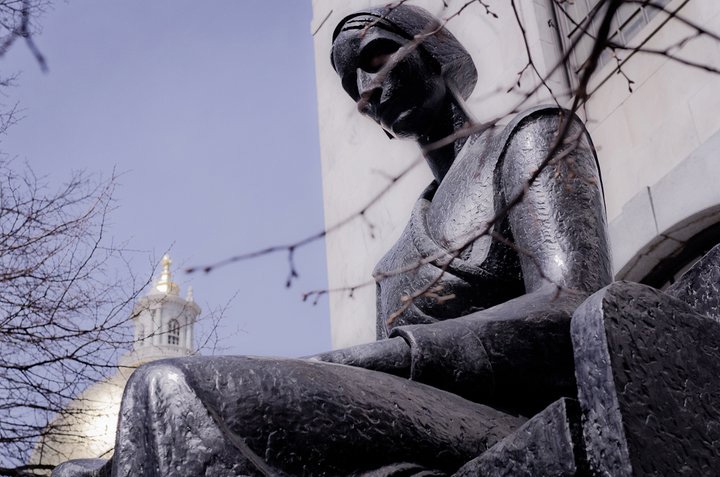
If you know of Mary Barrett Dyer, perhaps it’s the memorial statue at the Massachusetts State House; or that she was the Quaker woman hanged in Boston in 1660.

Mary was born in London at the time the King James Bible was published, and was admired for her intellectual, spiritual, and physical beauty. She and William Dyer were married under Anglican liturgy at St. Martin-in-the-Fields, but in 1635, they emigrated to ultra-Puritan Boston in Massachusetts Bay Colony, and were immediately admitted to membership in the First Church. (Some people committed suicide because their membership was denied.) The Dyers had to conform to Puritan ways to be accepted so quickly. However, Governor Winthrop observed in 1637 that Mary was “addicted to revelations.”

Mary became a disciple of Anne Hutchinson, a religious dissident who claimed that God revealed insights about scripture to her—a “weak-minded” (but highly-educated) woman. She pointed out that instead of trying in vain to earn salvation by perfectly keeping the law, believers were set free from eternal damnation by God’s grace. They could trust divine leading in their conscience, with no need for intercessors or interpreters.

But the Puritan theocracy believed if every man did as he pleased, all would be anarchy. After several ecclesiastical trials, the Hutchinsons and Dyers and about 75 Massachusetts families were exiled for sedition and heresy. They purchased Rhode Island from the Indians, and founded a new colony in 1638.

Mary visited England in early 1652, where she observed several new religious movements, including the Religious Society of Friends (Quakers). In some respects similarly to Anne Hutchinson, the Friends believed that Old Testament laws were obsolete, and had been replaced by God’s voice in the individual’s conscience, which was revealed during times of silent reflection and worship. They experienced God as Light and overwhelming love, in contrast to the vengeful Judge who predestined only certain people for eternal life. Some of the scripture they quoted included:
God is light; in him there is no darkness at all. … If we walk in the light, as he is in the light, we have fellowship with one another, and the blood of Jesus, his Son, purifies us from all sin. 1 John 1:5-7.
Believe in the light while you have the light, so that you may become children of light. ~Jesus. John 12:36.
“For you were once darkness, but now you are light in the Lord. Live as children of light.” Ephesians 5:8

In 1657, Mary returned to America, was accused of being a Quaker, and was cast into Boston’s prison for weeks before William Dyer learned of it and rescued her. Thus began three years of Mary’s repeatedly defying religious oppression to gain relief and freedom for the violently persecuted.

Quakers in New England were fined, beaten, branded, whipped with a knotted cord, banished, tied to carts and dragged from town to town, imprisoned without food or heat in winter, and banished “on pain of death” for their efforts and beliefs.


For supporting Quakers, Mary was arrested and imprisoned at least five times, and defied banishment. Finally, she was sentenced to death. She wrote a letter to the General Court on the night before her execution date. “I therefore declare that in the fear, peace, and love of God I came … and have found such favor in his sight as to offer up my life freely for his truth and people’s sakes. If this life were freely granted by you, it would not avail me to accept it from you, so long as I shall daily hear or see the suffering of my dear brethren and sisters.”

She believed that her death would be so shocking to the public that it would bring about the end of the severe tortures and repression of Quakers by the Puritan leaders. Many Puritans sympathized with and helped Quakers, and had begun to turn away from their harsh, vicious government. Fearing political unrest, the court granted a reprieve when she was on the gallows. She was imprisoned in Plymouth two weeks later, spent the winter at Long Island, then deliberately returned to Boston seven months later—to obey God’s command, and commit civil disobedience.

She was again condemned to death, and was hanged on June 1, 1660. Because her vengeful Puritan former pastor offered a cloth to cover her face, I believe that the Light was strong on her countenance.

Mary’s sacrifice was successful. Her letters were presented posthumously to Charles II, who ended executions for religious offenses. Her husband and close friends had significant influence on the 1663 Rhode Island royal charter of liberties that granted freedom of conscience to worship (or not), and retained separation of church and state. The charter was a model for the US Constitution’s Bill of Rights, which has in turn been the beacon of light for constitutions around the world.

The light shines in the darkness, and the darkness has not overcome it. John 1:5.

_____________
Christy K Robinson blogs about Mary Dyer while she writes a biographical novel on the Dyers of London and Rhode Island, who are her 12th-generation ancestors.

Tuesday, 4 December 2012

Light as a Choice


Guest post by Christy English

“The planet does not need more successful people. The planet desperately needs more peacemakers, healers, restorers, storytellers, and lovers of all kinds.”
His Holiness, the Dalai Lama


We get to choose whether or not to be light bringers. In every moment, whatever actions we take, we can bring light or darkness. Of course, it is often easier to focus on ourselves, our petty problems, our losses, our defeats.

The shadows are distracting to the point that we think they’re all there is. But light makes shadow, even if the Source is unseen.

The Light that came into the world on the birth of Christ has always been with us, and will always be. Like the green, verdant, ever-living Viriditas that Hildegard von Bingen wrote of, this light fills the world. We carry it in our hearts, whatever our faith or lack thereof. We are a part of this river of light that is moving through the world, whether we know it or not.

In every moment of every day, we can choose to bring light to a situation, or not. In the quote above, I think His Holiness is asking us to think of our daily lives, and how we can do better in each moment. It is an imperfect world, and we are imperfect, but that does not change our responsibility, to ourselves or to each other.


In order to express this light in our lives, however, we must find it.

Every tradition has it own path into this river of light. Prayer, meditation, a walk in a green wood, facing the ocean, the desert, the sky. Any or all of these might work, or they might not.

Only you can discover your own path into the light that lives within you. Even to look is an act of faith. Even to look is to begin to find it.

Our breath is the simplest way to open ourselves to the possibility that this light exists, that it is not a fairy tale told by fools to quiet the masses. Our breath is an ever-moving river, a mirror of that divine grace that lives within us all. You might choose to sit, to let everything else go, and to follow it.


This perhaps is the hardest thing for us to do in this modern world, to simply sit and follow our breath wherever it leads. But know that this task was hard for every man and woman who did it before you. You are not alone in this. You are a link in a chain of seekers that leads from the beginning of time, to now, and onward into a unknown future that none of us living today will ever see.

So you might find a spot, indoors or out. You might choose to stand in place, or sit, and simply breathe. You will find that the breath is not simple, that the shadows are there as well, but keep following it. The light is there, too, behind this world, supporting it, nurturing it, waiting until we all decide that we want to come home.


Christy English is the author of the Regency romance, HOW TO TAME A WILLFUL WIFE as well as the historical novels THE QUEEN’S PAWN and TO BE QUEEN about the life of Eleanor of Aquitaine. Please visit her at http://www.ChristyEnglish.com

Monday, 3 December 2012

Thoughts after the first Sunday in Advent


Great Milton Parish Church, Oxfordshire


Guest post by Stephanie Cowell, continuing our Viriditas Interfaith Advent series


Advent reminds me why I first began to haunt churches.  It all comes back again.

I am a church mouse, unable to pass one without pushing open doors and finding myself in a deeply moving place. I particularly love small stone churches dimly lit, full of candlelight and old incense. Our lives change so fast; you go to sleep and find the world changed in the morning.  And so I go through England and Europe pushing open the wood doors of churches with faded frescos on the wall, kneelers embroidered by the altar guild, dipping candles and worn prayer books to find my roots and my stability.

I wasn’t raised with any spiritual tradition and I think always wanted one. In my early forties, I became an Anglican.  I could have chosen a number of paths but this one I think found me. I live in the heart of New York City and unreasonably wanted to belong to a small English church. Unreasonably I found one down the street.  We use the original 16th century Common Prayer translations, the very same words which Shakespeare knew by heart.  I hear the church bells through my window. I live in one of the greatest, fastest-paced cities in the world, and belong to an English parish church.

Yesterday, December 2nd, Advent (the period of waiting for the birth in Bethlehem) began. There was anticipation in the air of all sorts of mysterious but comforting things, mysteries which are both fresh and comfortably worn as childhood books. We are traveling the weeks until Christmastide.  We are waiting for something we know will come in this world where you do not always know.

I was writing my first novel at the time I became an Anglican; it was an Elizabethan novel about an actor who longs to be a priest, and has several scenes set in and around the church of St. Mary Aldermanbury, near Cripplegate in London. The church was first built around 1100 and destroyed in the Great Fire of 1666 and then went on to a complicated history of rebuilding. Of all the hundreds of churches I have visited, this one that I have only seen in my mind (now only foundation stones and a garden remain) is one of the dearest. My hero’s journey of faith became mine or perhaps it was the other way around. The novel Nicholas Cooke: actor, soldier, physician, priest, the first book of a trilogy, has gone on to its own rich journey.

Today in church they sang the great Litany of Thomas Tallis (died 1585). The Litanist led the procession around the church singing the petitions, followed by acolytes bearing candles, clergy and the congregation. The words were the same as heard by the Elizabethans. “That it may please thee to give and preserve to our use the kindly fruits of the earth, so as in due time we may enjoy them; We beseech thee to hear us, good Lord.”


That all our good wishes may be heard and granted! And in this season of Advent we can believe that they are heard and meanwhile, as we wait and listen, so much of what we long for seems completely possible.
___________________________
About the author: Historical novelist Stephanie Cowell is the author of Nicholas Cooke, The Physician of London, The Players: a novel of the young Shakespeare, Marrying Mozart and Claude & Camille: a novel of Monet. She is the recipient of the American Book Award. Her work has been translated into nine languages. She is currently working on several projects. Her website is http://www.stephaniecowell.com


Sunday, 2 December 2012

Hildegard's House of Light


Elizabeth Erickson’s 2008 painting “Hildegard’s House of Light.” 


Today marks the First Sunday of Advent and the first post of our Viriditas Interfaith Advent Calendar, “Journey into Light.”

Here in Northern England, I find myself plunging into the depths of midwinter darkness. It is in this womb of night and stillness that the Light is reborn. Through the ages and across cultures, world faith traditions have marked this sacred passage through the darkness, as our guest bloggers shall explore in the coming days of Advent.

In Christian tradition, Advent is a period of expectant waiting, of anticipating the birth of Christ. The word Advent comes from the Latin adventus, which means “coming.” This First Sunday of Advent marks the beginning of the Western Christian liturgical year.

The Advent wreath and Advent calendar are relatively recent innovations. Christmas and Advent celebrations have gone through many permutations throughout history, as our guest bloggers will reveal, from boisterous celebrations with mummers and feasting to Oliver Cromwell’s Puritan backlash in which he outlawed Christmas because he believed the feast was far too pagan.

Back in Hildegard von Bingen's day, in the 12th century, Advent was a season of fasting and penitence in preparation for the Twelve Days of Christmas, which begin on Christmas Eve and end on January 6, the Feast of the Epiphany.

The season would have been especially numinous for Hildegard as a child anchorite at the remote Benedictine monastery of Disibodenberg. Imagine the enduring the depths of midwinter without central heating or electric lights, in an age when even religious people believed that there were demons lurking in the shadows. This would have pitched Hildegard into the deep drama of the season—the rebirth of the Light out of teeming darkness.

One German seasonal tradition that young Hildegard might have treasured was the Barbara Zweig, or the Barbara Branch. This was a branch cut from a fruit bearing tree on the Feast of Saint Barbara, December 4. Kept in a vase of water in a warm and sunlit corner, it would bloom on Christmas Day.

There were other, more atavistic traditions associated with the season. In Northern Europe, long before the Christian era, the Twelve Nights of Yule were held in awe—time out of time when fate hung suspended, when secrets were revealed and fortunes could be reversed, when the most powerful magic was afoot. Well into the Christian era, people believed that the ghostly Wild Hunt still roared across the midwinter skies along with the gales and storm winds.

I experienced these traditions first hand when I lived in Germany. In the Bavarian town of Kirchseeon, just east of Munich, mummers in hand-carved wooden masks perform the “Perchtenlauf,” a wild torchlit procession through the winter forest to awaken the dormant nature spirits and call back the dwindling sun. I'll discuss these folkways in greater depth in another post.


Now we return to young Hildegard, the child anchorite at Disibodenberg Monastery.

Here is an excerpt from Illuminations: A Novel of Hildegard von Bingen


After Vespers, I went to see if our Barbara Branch still had enough water. Though the buds had once seemed to swell, it now felt like a dead twig I could snap between my fingers. The forest would not stop haunting me. How the wild places called out to me in the face of Jutta’s direst warnings. Again and again she told me that I must dread everything dark and untamed.

Demons ruled the nocturnal hours, she insisted. On stormy nights, outside our anchorage walls, trees writhed, tossing their branches against the moon-drenched sky. As I lay in my narrow bed, my ears rang with the shrieking wind, the cries of owls and wolves in search of prey.  

Little did it matter that Christmas was fast approaching. For centuries before the Irish missionaries brought the faith of Christ to this land, before Carolus Magnus toppled the Irminsul, the idolatrous pillar of the heathens, my ancestors had held the Rauhnaechte, the Twelve Nights of Yuletide, in awe—time out of time when fate hung suspended, when secrets were revealed and fortunes could be reversed. This I knew from Walburga’s tales. The servants and peasant folk back home had muttered stories of the Old Ones roaring across the midwinter skies: the Wild Hunter of a thousand names in pursuit of his White Lady with her streaming hair and starry distaff, the whirlwind before the storm.

Leaving Jutta to her dreams, I crept out of bed and stole into the courtyard where I pranced barefoot in the swirling snowflakes like the mummers who came to Bermersheim every Yuletide in their fearsome wooden masks to frighten away harmful spirits.

A gale howled overhead, and the cold stung my soles, sending me spinning as the Wild Hunt of Walburga’s nursery stories raged overhead, that endless stream of unbanished gods and the souls of the unchristened dead. Anyone who dared venture out on a night such as this risked being swept along in that unearthly train.

But did I cross myself and flee inside to safety? No, I raised my face to the clouds racing across the full moon and I begged those invisible riders to take me with them.


Clouds shrouded the moon. Everything went black. I plummeted, down and down, as if there would be no end to my falling. De profundis clamavi ad te. Gazing up from the depths, I saw a circle of sky, now emptied of moon and stars. Had I been cast into hell for my sin? From out of that murk came a white cloud bursting with a light that was alive, pulsing and growing until it blazed like a thousand suns.

In that gleaming I saw a maiden shine in such splendor that I could hardly look at her but only catch glances like fragments from a dream. Her mantle, whiter than snow, glittered like a heavenful of stars. In her right hand she cradled the sun and moon. On her breast, covering her heart, was an ivory tablet and upon that tablet I saw a man the color of sapphire. A chorus rose like birdsong on an April dawn—all of creation calling this maiden Lady. The maiden’s own voice rose above it, as achingly beautiful as Jutta’s singing.

I bore you from the womb before the morning star.

I didn’t know whether the maiden was speaking to me, lost and wretched, or to the sapphire man in her breast. My vision of the Lady was lost but her voice lingered. You are here for a purpose though you don’t understand it yet.

Barefoot and mother naked, I found myself within a greening garden so beautiful, it made me cry out. Each blade of grass and newly unfurled spring leaf shimmered in the sun. Every bush and tree was frothy with blossom and heavy with fruit at the same time. In the midst of that glory, the Tree of Life with its jeweled apples winked at me, and yet I saw no serpent. The Lady’s voice whispered: See the eternal paradise that has never fallen.

I saw a great wheel with the all-embracing arms of God at its circumference, the Lady at its heart. Everything she touched greened and bloomed.


Pealing bells wrenched me back into this world. The monks were ringing in Christmas morning. I lay on my pallet, the blankets piled over me, my legs swaddled in damp cloth. Above me hovered a maiden with glowing blue eyes. Her veil had slipped and the sun shone through her halo of cropped auburn curls. Whispering my name, Jutta held out a blossoming apple branch, each pink and white flower scented of the Eden I had glimpsed.