Saturday, 8 December 2012

Enlightened


Dear Readers, due to the incompetence of British Telecom, I have been without internet broadband for a number of days, and thus our Viriditas Advent Blog was on hiatus. I needed to get a viable laptop and hotspot to work with and download Google Chrome before I could resume posting. But here, at long last,
is Christy K. Robinson's poignant guest post about Mary Barrett Dyer, an early American who died  defending religious freedom.


Guest Post by Christy K Robinson

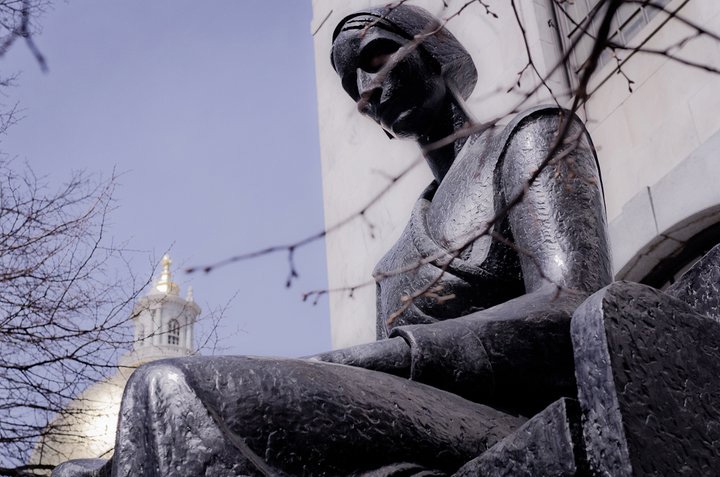
If you know of Mary Barrett Dyer, perhaps it’s the memorial statue at the Massachusetts State House; or that she was the Quaker woman hanged in Boston in 1660.

Mary was born in London at the time the King James Bible was published, and was admired for her intellectual, spiritual, and physical beauty. She and William Dyer were married under Anglican liturgy at St. Martin-in-the-Fields, but in 1635, they emigrated to ultra-Puritan Boston in Massachusetts Bay Colony, and were immediately admitted to membership in the First Church. (Some people committed suicide because their membership was denied.) The Dyers had to conform to Puritan ways to be accepted so quickly. However, Governor Winthrop observed in 1637 that Mary was “addicted to revelations.”

Mary became a disciple of Anne Hutchinson, a religious dissident who claimed that God revealed insights about scripture to her—a “weak-minded” (but highly-educated) woman. She pointed out that instead of trying in vain to earn salvation by perfectly keeping the law, believers were set free from eternal damnation by God’s grace. They could trust divine leading in their conscience, with no need for intercessors or interpreters.

But the Puritan theocracy believed if every man did as he pleased, all would be anarchy. After several ecclesiastical trials, the Hutchinsons and Dyers and about 75 Massachusetts families were exiled for sedition and heresy. They purchased Rhode Island from the Indians, and founded a new colony in 1638.

Mary visited England in early 1652, where she observed several new religious movements, including the Religious Society of Friends (Quakers). In some respects similarly to Anne Hutchinson, the Friends believed that Old Testament laws were obsolete, and had been replaced by God’s voice in the individual’s conscience, which was revealed during times of silent reflection and worship. They experienced God as Light and overwhelming love, in contrast to the vengeful Judge who predestined only certain people for eternal life. Some of the scripture they quoted included:
God is light; in him there is no darkness at all. … If we walk in the light, as he is in the light, we have fellowship with one another, and the blood of Jesus, his Son, purifies us from all sin. 1 John 1:5-7.
Believe in the light while you have the light, so that you may become children of light. ~Jesus. John 12:36.
“For you were once darkness, but now you are light in the Lord. Live as children of light.” Ephesians 5:8

In 1657, Mary returned to America, was accused of being a Quaker, and was cast into Boston’s prison for weeks before William Dyer learned of it and rescued her. Thus began three years of Mary’s repeatedly defying religious oppression to gain relief and freedom for the violently persecuted.

Quakers in New England were fined, beaten, branded, whipped with a knotted cord, banished, tied to carts and dragged from town to town, imprisoned without food or heat in winter, and banished “on pain of death” for their efforts and beliefs.


For supporting Quakers, Mary was arrested and imprisoned at least five times, and defied banishment. Finally, she was sentenced to death. She wrote a letter to the General Court on the night before her execution date. “I therefore declare that in the fear, peace, and love of God I came … and have found such favor in his sight as to offer up my life freely for his truth and people’s sakes. If this life were freely granted by you, it would not avail me to accept it from you, so long as I shall daily hear or see the suffering of my dear brethren and sisters.”

She believed that her death would be so shocking to the public that it would bring about the end of the severe tortures and repression of Quakers by the Puritan leaders. Many Puritans sympathized with and helped Quakers, and had begun to turn away from their harsh, vicious government. Fearing political unrest, the court granted a reprieve when she was on the gallows. She was imprisoned in Plymouth two weeks later, spent the winter at Long Island, then deliberately returned to Boston seven months later—to obey God’s command, and commit civil disobedience.

She was again condemned to death, and was hanged on June 1, 1660. Because her vengeful Puritan former pastor offered a cloth to cover her face, I believe that the Light was strong on her countenance.

Mary’s sacrifice was successful. Her letters were presented posthumously to Charles II, who ended executions for religious offenses. Her husband and close friends had significant influence on the 1663 Rhode Island royal charter of liberties that granted freedom of conscience to worship (or not), and retained separation of church and state. The charter was a model for the US Constitution’s Bill of Rights, which has in turn been the beacon of light for constitutions around the world.

The light shines in the darkness, and the darkness has not overcome it. John 1:5.

_____________
Christy K Robinson blogs about Mary Dyer while she writes a biographical novel on the Dyers of London and Rhode Island, who are her 12th-generation ancestors.

Tuesday, 4 December 2012

Light as a Choice


Guest post by Christy English

“The planet does not need more successful people. The planet desperately needs more peacemakers, healers, restorers, storytellers, and lovers of all kinds.”
His Holiness, the Dalai Lama


We get to choose whether or not to be light bringers. In every moment, whatever actions we take, we can bring light or darkness. Of course, it is often easier to focus on ourselves, our petty problems, our losses, our defeats.

The shadows are distracting to the point that we think they’re all there is. But light makes shadow, even if the Source is unseen.

The Light that came into the world on the birth of Christ has always been with us, and will always be. Like the green, verdant, ever-living Viriditas that Hildegard von Bingen wrote of, this light fills the world. We carry it in our hearts, whatever our faith or lack thereof. We are a part of this river of light that is moving through the world, whether we know it or not.

In every moment of every day, we can choose to bring light to a situation, or not. In the quote above, I think His Holiness is asking us to think of our daily lives, and how we can do better in each moment. It is an imperfect world, and we are imperfect, but that does not change our responsibility, to ourselves or to each other.


In order to express this light in our lives, however, we must find it.

Every tradition has it own path into this river of light. Prayer, meditation, a walk in a green wood, facing the ocean, the desert, the sky. Any or all of these might work, or they might not.

Only you can discover your own path into the light that lives within you. Even to look is an act of faith. Even to look is to begin to find it.

Our breath is the simplest way to open ourselves to the possibility that this light exists, that it is not a fairy tale told by fools to quiet the masses. Our breath is an ever-moving river, a mirror of that divine grace that lives within us all. You might choose to sit, to let everything else go, and to follow it.


This perhaps is the hardest thing for us to do in this modern world, to simply sit and follow our breath wherever it leads. But know that this task was hard for every man and woman who did it before you. You are not alone in this. You are a link in a chain of seekers that leads from the beginning of time, to now, and onward into a unknown future that none of us living today will ever see.

So you might find a spot, indoors or out. You might choose to stand in place, or sit, and simply breathe. You will find that the breath is not simple, that the shadows are there as well, but keep following it. The light is there, too, behind this world, supporting it, nurturing it, waiting until we all decide that we want to come home.


Christy English is the author of the Regency romance, HOW TO TAME A WILLFUL WIFE as well as the historical novels THE QUEEN’S PAWN and TO BE QUEEN about the life of Eleanor of Aquitaine. Please visit her at http://www.ChristyEnglish.com

Monday, 3 December 2012

Thoughts after the first Sunday in Advent


Great Milton Parish Church, Oxfordshire


Guest post by Stephanie Cowell, continuing our Viriditas Interfaith Advent series


Advent reminds me why I first began to haunt churches.  It all comes back again.

I am a church mouse, unable to pass one without pushing open doors and finding myself in a deeply moving place. I particularly love small stone churches dimly lit, full of candlelight and old incense. Our lives change so fast; you go to sleep and find the world changed in the morning.  And so I go through England and Europe pushing open the wood doors of churches with faded frescos on the wall, kneelers embroidered by the altar guild, dipping candles and worn prayer books to find my roots and my stability.

I wasn’t raised with any spiritual tradition and I think always wanted one. In my early forties, I became an Anglican.  I could have chosen a number of paths but this one I think found me. I live in the heart of New York City and unreasonably wanted to belong to a small English church. Unreasonably I found one down the street.  We use the original 16th century Common Prayer translations, the very same words which Shakespeare knew by heart.  I hear the church bells through my window. I live in one of the greatest, fastest-paced cities in the world, and belong to an English parish church.

Yesterday, December 2nd, Advent (the period of waiting for the birth in Bethlehem) began. There was anticipation in the air of all sorts of mysterious but comforting things, mysteries which are both fresh and comfortably worn as childhood books. We are traveling the weeks until Christmastide.  We are waiting for something we know will come in this world where you do not always know.

I was writing my first novel at the time I became an Anglican; it was an Elizabethan novel about an actor who longs to be a priest, and has several scenes set in and around the church of St. Mary Aldermanbury, near Cripplegate in London. The church was first built around 1100 and destroyed in the Great Fire of 1666 and then went on to a complicated history of rebuilding. Of all the hundreds of churches I have visited, this one that I have only seen in my mind (now only foundation stones and a garden remain) is one of the dearest. My hero’s journey of faith became mine or perhaps it was the other way around. The novel Nicholas Cooke: actor, soldier, physician, priest, the first book of a trilogy, has gone on to its own rich journey.

Today in church they sang the great Litany of Thomas Tallis (died 1585). The Litanist led the procession around the church singing the petitions, followed by acolytes bearing candles, clergy and the congregation. The words were the same as heard by the Elizabethans. “That it may please thee to give and preserve to our use the kindly fruits of the earth, so as in due time we may enjoy them; We beseech thee to hear us, good Lord.”


That all our good wishes may be heard and granted! And in this season of Advent we can believe that they are heard and meanwhile, as we wait and listen, so much of what we long for seems completely possible.
___________________________
About the author: Historical novelist Stephanie Cowell is the author of Nicholas Cooke, The Physician of London, The Players: a novel of the young Shakespeare, Marrying Mozart and Claude & Camille: a novel of Monet. She is the recipient of the American Book Award. Her work has been translated into nine languages. She is currently working on several projects. Her website is http://www.stephaniecowell.com


Sunday, 2 December 2012

Hildegard's House of Light


Elizabeth Erickson’s 2008 painting “Hildegard’s House of Light.” 


Today marks the First Sunday of Advent and the first post of our Viriditas Interfaith Advent Calendar, “Journey into Light.”

Here in Northern England, I find myself plunging into the depths of midwinter darkness. It is in this womb of night and stillness that the Light is reborn. Through the ages and across cultures, world faith traditions have marked this sacred passage through the darkness, as our guest bloggers shall explore in the coming days of Advent.

In Christian tradition, Advent is a period of expectant waiting, of anticipating the birth of Christ. The word Advent comes from the Latin adventus, which means “coming.” This First Sunday of Advent marks the beginning of the Western Christian liturgical year.

The Advent wreath and Advent calendar are relatively recent innovations. Christmas and Advent celebrations have gone through many permutations throughout history, as our guest bloggers will reveal, from boisterous celebrations with mummers and feasting to Oliver Cromwell’s Puritan backlash in which he outlawed Christmas because he believed the feast was far too pagan.

Back in Hildegard von Bingen's day, in the 12th century, Advent was a season of fasting and penitence in preparation for the Twelve Days of Christmas, which begin on Christmas Eve and end on January 6, the Feast of the Epiphany.

The season would have been especially numinous for Hildegard as a child anchorite at the remote Benedictine monastery of Disibodenberg. Imagine the enduring the depths of midwinter without central heating or electric lights, in an age when even religious people believed that there were demons lurking in the shadows. This would have pitched Hildegard into the deep drama of the season—the rebirth of the Light out of teeming darkness.

One German seasonal tradition that young Hildegard might have treasured was the Barbara Zweig, or the Barbara Branch. This was a branch cut from a fruit bearing tree on the Feast of Saint Barbara, December 4. Kept in a vase of water in a warm and sunlit corner, it would bloom on Christmas Day.

There were other, more atavistic traditions associated with the season. In Northern Europe, long before the Christian era, the Twelve Nights of Yule were held in awe—time out of time when fate hung suspended, when secrets were revealed and fortunes could be reversed, when the most powerful magic was afoot. Well into the Christian era, people believed that the ghostly Wild Hunt still roared across the midwinter skies along with the gales and storm winds.

I experienced these traditions first hand when I lived in Germany. In the Bavarian town of Kirchseeon, just east of Munich, mummers in hand-carved wooden masks perform the “Perchtenlauf,” a wild torchlit procession through the winter forest to awaken the dormant nature spirits and call back the dwindling sun. I'll discuss these folkways in greater depth in another post.


Now we return to young Hildegard, the child anchorite at Disibodenberg Monastery.

Here is an excerpt from Illuminations: A Novel of Hildegard von Bingen


After Vespers, I went to see if our Barbara Branch still had enough water. Though the buds had once seemed to swell, it now felt like a dead twig I could snap between my fingers. The forest would not stop haunting me. How the wild places called out to me in the face of Jutta’s direst warnings. Again and again she told me that I must dread everything dark and untamed.

Demons ruled the nocturnal hours, she insisted. On stormy nights, outside our anchorage walls, trees writhed, tossing their branches against the moon-drenched sky. As I lay in my narrow bed, my ears rang with the shrieking wind, the cries of owls and wolves in search of prey.  

Little did it matter that Christmas was fast approaching. For centuries before the Irish missionaries brought the faith of Christ to this land, before Carolus Magnus toppled the Irminsul, the idolatrous pillar of the heathens, my ancestors had held the Rauhnaechte, the Twelve Nights of Yuletide, in awe—time out of time when fate hung suspended, when secrets were revealed and fortunes could be reversed. This I knew from Walburga’s tales. The servants and peasant folk back home had muttered stories of the Old Ones roaring across the midwinter skies: the Wild Hunter of a thousand names in pursuit of his White Lady with her streaming hair and starry distaff, the whirlwind before the storm.

Leaving Jutta to her dreams, I crept out of bed and stole into the courtyard where I pranced barefoot in the swirling snowflakes like the mummers who came to Bermersheim every Yuletide in their fearsome wooden masks to frighten away harmful spirits.

A gale howled overhead, and the cold stung my soles, sending me spinning as the Wild Hunt of Walburga’s nursery stories raged overhead, that endless stream of unbanished gods and the souls of the unchristened dead. Anyone who dared venture out on a night such as this risked being swept along in that unearthly train.

But did I cross myself and flee inside to safety? No, I raised my face to the clouds racing across the full moon and I begged those invisible riders to take me with them.


Clouds shrouded the moon. Everything went black. I plummeted, down and down, as if there would be no end to my falling. De profundis clamavi ad te. Gazing up from the depths, I saw a circle of sky, now emptied of moon and stars. Had I been cast into hell for my sin? From out of that murk came a white cloud bursting with a light that was alive, pulsing and growing until it blazed like a thousand suns.

In that gleaming I saw a maiden shine in such splendor that I could hardly look at her but only catch glances like fragments from a dream. Her mantle, whiter than snow, glittered like a heavenful of stars. In her right hand she cradled the sun and moon. On her breast, covering her heart, was an ivory tablet and upon that tablet I saw a man the color of sapphire. A chorus rose like birdsong on an April dawn—all of creation calling this maiden Lady. The maiden’s own voice rose above it, as achingly beautiful as Jutta’s singing.

I bore you from the womb before the morning star.

I didn’t know whether the maiden was speaking to me, lost and wretched, or to the sapphire man in her breast. My vision of the Lady was lost but her voice lingered. You are here for a purpose though you don’t understand it yet.

Barefoot and mother naked, I found myself within a greening garden so beautiful, it made me cry out. Each blade of grass and newly unfurled spring leaf shimmered in the sun. Every bush and tree was frothy with blossom and heavy with fruit at the same time. In the midst of that glory, the Tree of Life with its jeweled apples winked at me, and yet I saw no serpent. The Lady’s voice whispered: See the eternal paradise that has never fallen.

I saw a great wheel with the all-embracing arms of God at its circumference, the Lady at its heart. Everything she touched greened and bloomed.


Pealing bells wrenched me back into this world. The monks were ringing in Christmas morning. I lay on my pallet, the blankets piled over me, my legs swaddled in damp cloth. Above me hovered a maiden with glowing blue eyes. Her veil had slipped and the sun shone through her halo of cropped auburn curls. Whispering my name, Jutta held out a blossoming apple branch, each pink and white flower scented of the Eden I had glimpsed.  

Thursday, 8 November 2012

ILLUMINATIONS Amazon Reader Review Contest


Dear Hildegard fans,

Writers love to hear feedback on their work.

Post a Reader Review for Illuminations: A Novel of Hildegard von Bingen on Amazon.com or Amazon.co.uk and send me an email saying you've done so. The writer of the most insightful review will win a free CD of Anonymous 4's The Origin of Fire: Music and Visions of Hildegard von Bingen AND a free bottle of the Hildegard-themed Veriditas Perfume by Arabesque Aromas, made from all natural ingredients:

 Contest ends November 20. The winner will be announced shortly thereafter.

If you've already written a review and wish to enter, just send me an email.

Thanks so much for participating!

All good wishes from Mary


Wednesday, 31 October 2012

Blessed All Hallows


Last weekend in England, the clocks fell back. Now the long northern darkness is closing in. People who live in more southerly climes might have a hard time imagining just how DARK it is in the North in this waning end of the year.

Imagine the English gothic novel brought to life as a living reality, everything pitch black at 4:30 on an overcast day.

Today is one of the biggest turning points of the year--All Hallows Eve. Its secular and commercial manifestation with the mass-produced trick or treat paraphenalia cannot hold a candle to the true signficance and gravitas of this ancient feast.

All Hallows has its roots in the Celtic Samhain, which marked the end of the pastoral year and was considered particularly numinous, a time when the faery folk and the spirits of the dead roved abroad. This was a time of inclement weather, when the Wild Hunt, that endless stream of ancestral spirits, raged overhead--something that might feel all too close to home for those who dwell in Hurricane Sandy's path. Even in the digital age, we are still very much at the mercy of the elements and the all too fragile balance of nature.

Many of Samhain's folkways were preserved in the Christian feast of All Hallows, which had developed into a spectacular affair by the late Middle Ages, with church bells ringing all night to comfort the souls believed to be in purgatory. Did this custom have its origin in much older rites of ancestor veneration? This threshold feast opening the season of cold and darkness allowed people to confront their deepest held fears—that of death and what lay beyond. And their deepest longings—reunion with their cherished departed.

After the English Reformation, these old Catholic rites were outlawed, resulting in one of the longest struggles waged by Protestant reformers against any of the traditional ecclesiastical rituals. Lay people stubbornly continued to hold vigils for their dead—a rite that could be performed without a priest and in cover of darkness. Until the early 19th century in the Lancashire parish of Whalley, some families still gathered at midnight upon All Hallows Eve. One person held a large bunch of burning straw on a pitchfork while the others knelt in a circle and prayed for their beloved dead until the flames burned out.

Long after the Reformation, people persisted in giving round oatcakes, called Soul-Mass Cakes to soulers, the poor who went door to door singing Souling Songs as they begged for alms on the Feast of All Souls, November 2. Each cake eaten represented a soul released from purgatory, a mystical communion with the dead.

In Glossographia, published in 1674, Thomas Blount writes:

All Souls Day, November 2d: the custom of Soul Mass cakes, which are a kind of oat cakes, that some of the richer sorts in Lancashire and Herefordshire (among the Papists there) use still to give the poor upon this day; and they, in retribution of their charity, hold themselves obliged to say this old couplet:

God have your soul,
Bones and all.


What do these old traditions mean to us today?

All Hallows is not just a date on the calendar, but the entire tide, or season, in which we celebrate ancestral memory and commemorate our dead. This is also the season of storytelling, of re-membering the past. We honour all those who have gone before us. The veil between the seen and unseen grows thin and we may dream true.

Wishing a blessed All Hallows Tide to all!


Source: Ronald Hutton, The Stations of the Sun: A History of the Ritual Year in Britain

Links:

Soul Cake Recipes

Souling Songs


In 1106, on November 1, the Eve of All Souls, eight-year-old Hildegard von Bingen, a child dedicant to monastic life, endured a searing rite of passage that marked her death to the secular world and her new existence as an oblate-anchorite. (See the video at the top of the page.)


Excerpt from ILLUMINATIONS: A NOVEL OF HILDEGARD VON BINGEN

At dusk on the Eve of All Souls, the rite began.

In our guesthouse chamber, I froze, bare feet on the cold stone floor, as Jutta tugged my earthly garments over my head and let them tumble to the ground.

“You don’t need these anymore, ” she told me.

She wore nothing but a death shroud of sackcloth woven from coarsest, scratchiest goat hair. As goose pimples rose on my naked flesh, Jutta made me raise my arms so that she could fit an identical shroud over my body. The goat hair dug into me, making me want to claw my skin to relieve the itch.

Jutta then bowed her head as low as it could hang and shuffled out of the room, leaving me to shuffle after. We processed to the abbatial church, now alight with tapers, as though a funeral were underway.

At the west end of the church lay a bed of black earth strewn with bare branches and dead leaves. Jutta flung herself belly down in the dirt. Dust to dust. I bridled, my stomach lurching. I remembered the story of Saint Ursula, the 11,000 murdered virgins, the rotting flesh, and then it struck me like a blow, the full weight of what it meant to be an anchorite. The funeral tapers, the bed of earth—this night, I was to die. To be buried with Christ.

Flinging myself toward Mother who watched with the rest of the congregation, I mouthed the words save me. Mother’s face flushed. Weeping in earnest, she stepped toward me while my heart pounded in mad hope. But her gaze left me mute. It was as though she had taken a silken thread and sewed my lips shut so I could only mewl, as weak as a kitten, not sob or wail or rage. Taking my hands, Mother guided me downward, into that dirt.

“It’s God’s will, ” she whispered. “We must all obey those who stand above us.”

With trembling hands, she arranged my prone body till at last I lay corpse-still beside Jutta.

Holy water fell on my back like rain, wetting me through the prickly hair shirt. Incense and the stink of dank earth filled my nose. Finally the archbishop commanded me and Jutta to stand. Numb, my head ringing, I staggered to my feet and chanted the words they told me to chant.

Abbot Adilhum gave me and Jutta burning candles to hold in each hand.

“One for your love of God, ” he said as the hot wax dripped down to sear my fingers. “One for your love of your neighbors.”

I felt no love at all, only shuddering emptiness.

The monks sang Veni creator. At the abbot’s prompting, I mumbled, “Suspice me, Domine.” Receive me, Lord. I placed my candles beside Jutta’s on the altar before hurling myself back into the grave dirt beside Jutta. My ears burned as the monks chanted what even I recognized as the Office of the Dead.

“Rise, my daughters, ” said the archbishop, leading us out of the church and into our tomb, our sepulcher, the narrow cell built onto the edge of the church.

My eyes flooded as he swung his incense thurible round and round. There was only the low doorway and no windows, save for the screen viewing into the church and the revolving hatch where the monks could pass in food to Jutta and me without our even seeing who stood on the outside. Mother and Rorich were already lost to me, outside in the courtyard, chanting along with the monks. I’ll never see their faces again.

“Here I will stay forever, ” Jutta sang. “This is the home I have chosen.”

I choked and coughed as the archbishop sprinkled dust on us. Every part of my body shriveled as he spoke the Rite of Extreme Unction, reserved for those on their deathbed.

“Obey God, ” he told us before leaving our cell.

Tears slid from my eyes as I watched the lay brothers brick up the doorway that Jutta and I had passed through but would never be allowed to leave. As Jutta murmured her prayers, I lay rigid on that cold stone floor as though I were truly a corpse in my crypt.

When the last brick was laid in its place, blocking every hope of escape, Jutta took my hands and pulled me to my feet. In the light of the single taper the monks had left us, I saw her smile.

“My dearest dream has been made real, ” she said.

At that, she blew out the taper, and coffin-darkness enclosed us.

Sunday, 7 October 2012

Hildegard von Bingen: Doctor of the Church


Hildegard von Bingen: Doctor of the Church and Timeless Visionary    

Hildegard von Bingen (1098–1179) was a visionary abbess and polymath. She composed an entire corpus of sacred music and wrote nine books on subjects as diverse as theology, cosmology, botany, medicine, linguistics, and human sexuality, a prodigious intellectual outpouring that was unprecedented for a 12th-century woman. Her prophecies earned her the title Sybil of the Rhine.

Pope Benedict XVI canonized Hildegard on May 10, 2012—873 years after her death. Today, October 7, 2012, she will be elevated to Doctor of the Church, a rare and solemn title reserved for theologians who have significantly impacted Church doctrine.

But what does Hildegard mean for a wider secular audience today?

I believe her legacy remains hugely important for contemporary women.

While writing Illuminations: A Novel of Hildegard von Bingen, I kept coming up against the injustice of how women, who are often more devout than men, are condemned to stand at the margins of established religion, even in the 21st century. Women bishops still cause controversy in the Episcopalian Church while the previous Catholic pope, John Paul II, called a moratorium even on the discussion of women priests. Although Pope Benedict XVI is elevating Hildegard to Doctor of the Church, he is suppressing Hildegard’s modern day sisters--the nuns of the Leadership Council of Women Religious, who stand accused of radical feminism.

Modern women have the choice to wash their hands of organized religion altogether. But Hildegard didn’t even get to choose whether to enter monastic life—according to the Vita Sanctae Hildegardis, she was entombed in an anchorage at the age of eight. The Church of her day could not have been more patriarchal and repressive to women. Yet her visions moved her to create a faith that was immanent and life-affirming, one that can inspire us today.

Too often both religion and spirituality have been interpreted by and for men, but when women reveal their spiritual truths, a whole other landscape emerges, one we haven’t seen enough of. Hildegard opens the door to a luminous new world.

The cornerstone of Hildegard’s spirituality was Viriditas, or greening power, her revelation of the animating life force manifest in the natural world that infuses all creation with moisture and vitality. To her, the divine is manifest in every leaf and blade of grass. Just as a ray of sunlight is the sun, Hildegard believed that a flower or a stone is God, though not the whole of God. Creation reveals the face of the invisible creator.

“I, the fiery life of divine essence, am aflame beyond the beauty of the meadows,” the voice of God reveals in Hildegard’s visions, recorded in her book, Liber Divinorum. “I gleam in the waters, and I burn in the sun, moon and stars . . . . I awaken everything to life.”

Hildegard’s re-visioning of religion celebrated women and nature, and even perceived God as feminine, as Mother. Her vision of the universe was an egg inside the womb of God.

According to Barbara Newman’s book Sister of Wisdom: St. Hildegard’s Theology of the Feminine, Hildegard’s Sapientia, or Divine Wisdom, creates the cosmos by existing within it.

O power of wisdom!
You encompassed the cosmos,
Encircling and embracing all in one living orbit
With your three wings:
One soars on high,
One distills the earth’s essence,
And the third hovers everywhere.
Hildegard von Bingen, O virtus sapientia

Hildegard shows how visionary women might transform the most male-dominated faith traditions from within.

May Hildegard's luminous visions inspire us all.

My novel, Illuminations, based on Hildegard's dramatic life, is published October 9.